


The fourth Aleksandar Tišma International Literary Prize was ceremonially presented to Bosnian-Herzegovinian and Croatian writer and journalist Miljenko Jergović on 24 June 2026 at the Matica Srpska in Novi Sad, Serbia. The jury, composed of distinguished European writers and critics: Chair Ilma Rakusa, László Márton, Karl-Markus Gauß, Vladislava Gordić Petković, and Mathias Énard, selected Miljenko Jergović as the recipient of this year’s prize. The Aleksandar Tišma International Literary Prize was awarded to him in recognition of his outstanding lifetime contribution to literature and his overall literary oeuvre.
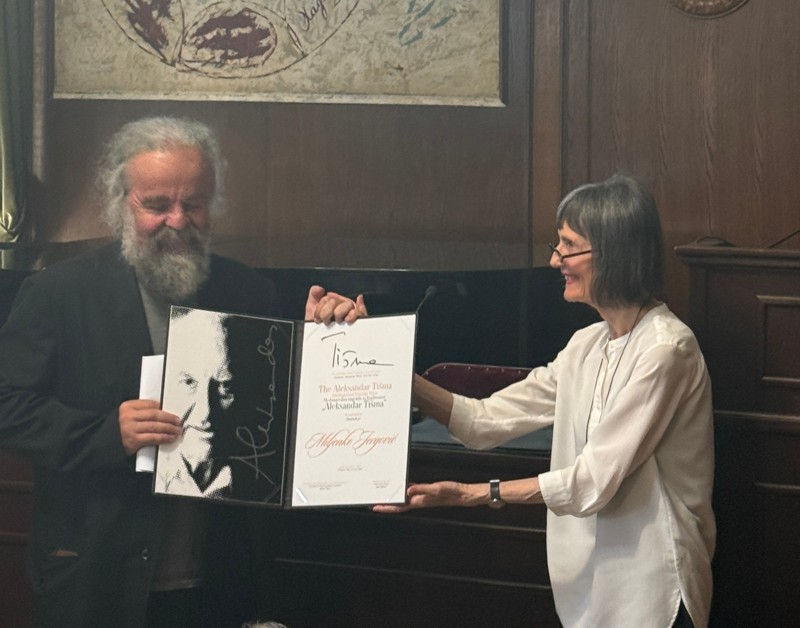


The prize was presented to the laureate by the Chair of the Jury, Ilma Rakusa. Speakers at the award ceremony included Milena Kulić (Matica Srpska), Andrej Tišma, Jury Chair Ilma Rakusa, jury member László Márton, and Bora Babić, Director of the Aleksandar Tišma Foundation.
The ceremony also featured an address by Miljenko Jergović, who spoke to the audience following the presentation of the award. The event was moderated by Ana Kukolj Jović.
From Ilma Rakusa’s Citation for the Award
There is no doubt: Miljenko Jergović is among the most internationally acclaimed contemporary writers from the former Yugoslavia. [...]
Peace, tolerance, and understanding: three concepts that define Jergović’s work and fundamentally shape his outlook as a writer.
Yet several of his books explore the theme of war. Beginning with the remarkable collection Sarajevo Marlboro (1994) and continuing with Trojica za Kartal: Sarajevski Marlboro Remastered, published in 2022, war here serves mainly as a backdrop rather than the central subject. Jergović is not interested in graphic brutality, violent gunfire, or victims soaked in blood. Instead, he reveals tragedy within people, in the human mind, and in everyday details that suddenly take on symbolic significance. [...]
Jergović is a brilliant observer of the human mind. He possesses an exceptional gift for observation and the rare ability to sketch characters with just a few precise strokes, making human relationships vividly tangible. [...]
Jergović [...] shows how people react to historical circumstances: as conformists, perpetrators, or victims. The novel explores themes of guilt and atonement, exile and displacement, and the search for identity in difficult times. Again and again, it returns to the question of what home is, or what it might be. Perhaps it is belonging through not belonging? [...]
One might say that all his literary works try to get close to things rather than to give definitive answers.
That does not prevent him from engaging in contemporary political debates through journalism and from taking firm stances in his sharp columns. Driven by a sense of responsibility, as both a writer and a citizen, he willingly confronts the hostility this may provoke. Fascist, racist, and ultranationalist tendencies must not be tolerated; here, there is no room for understanding. Jergović is highly attuned to the warning signs of ideological and linguistic distortion and responds to them with uncompromising criticism. [...]
Jergović’s sympathies are always with the weak, the dispossessed, and the vulnerable. He consistently advocates a view of humanity that resists categorization. He is skeptical of all forms of heroism and of its accompanying symbols: monuments, flags, and public honors. To him, history consists of small stories – stories that reveal human beings in all their contradictory complexity.
Miljenko Jergović’s Acceptance Speech upon Receiving the Aleksandar Tišma International Literary Prize
It is unusual to receive an award bearing the name of someone you once knew. It is even more unusual when it happens for the second time, involving the same person. But let me tell the story from the beginning.
I first met Aleksandar Tišma in the summer of 2000 in Solothurn, Switzerland, at the local literary festival. We were seated before an audience and invited to engage in a dialogue about reconciliation among peoples who had recently been at war. At the time, such things were very much in fashion: Tišma was expected to represent the Serbs, while I was to represent Bosnians and Croats. If any witnesses from that audience are still with us, they might tell you how well we performed our assigned roles. As for me, I was speaking with one of my writers; he was speaking with me. It seemed to me that we understood one another far too well for the parts we had been assigned. He asked whether I would come to Novi Sad to give a literary reading. In those still early post-war years, that was not as simple a question as it may seem today. I told him I would be glad to come. The audience applauded.
Some twenty years later, long after Aleksandar Tišma had moved entirely into the words and sentences of his books, during one of my visits to Novi Sad I was handed a letter, typed on a typewriter in Novi Sad on 16 September 2000. In it, after describing the circumstances of our meeting in Solothurn, Tišma proposed that the Cultural Centre of Novi Sad organize a literary evening with me.
He had meant it seriously. His question to me had not been a polite formality or a ceremonial gesture. He had not asked it merely to earn the audience’s applause.
That was the first time I received the Aleksandar Tišma Award. In fact, I received it on that very day, 16 September 2000, although I was not aware of it then. There are awards of which the recipient remains unaware. Those may well be the most important ones.
In the spring of 2026, a jury composed of distinguished writers whose work I am fortunate to read, and of people whom I admire and cherish from afar, awarded me the Aleksandar Tišma Award once again. This time Tišma himself is not aware of it, and all I can do is hope that he would have looked upon it with sympathy.
He was a man who took other people seriously. He believed that we are capable of doing something for one another. What a person chose to be, by conviction and by choice, mattered to him far more than what had been determined by birth or recorded on a birth certificate. He tried to do something for other people. He did not concern himself with empty and meaningless ceremonies. He did not belong to the flock of sentimental peacemakers in love with their own mission. Indeed, he was not sentimental at all. He was kindly ill-tempered. He did not identify himself with victims; rather, he sought to prevent people from becoming victims. Victims remain trapped in their misfortune for the rest of their lives.
And he was a great writer. My great writer.
Thank you for honouring me with his name.